+27 (0) 11 455 1726
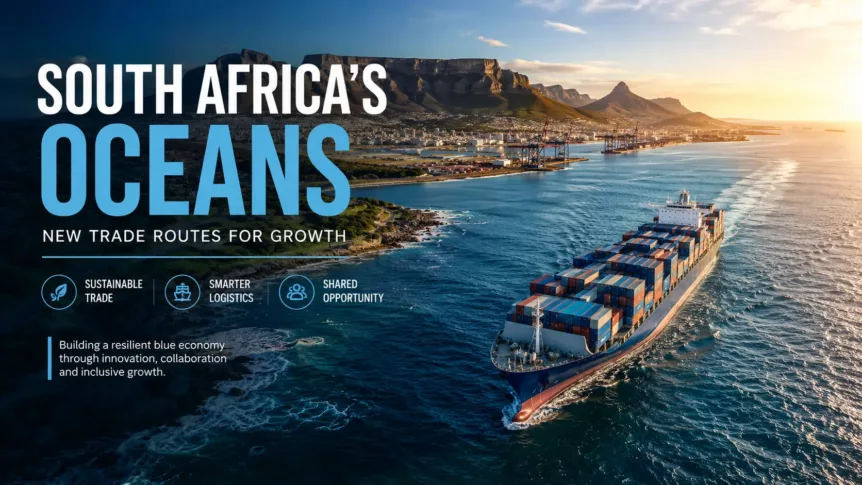
South Africa’s Oceans: New Trade Routes for Growth
South Africa’s 3,000km coastline has long been viewed as little more than a strategic shipping corridor, a point where global vessels pass between the Indian and Atlantic Oceans. But today, that narrative is shifting.
As global sustainability demands reshape trade and logistics, South Africa’s ocean economy is increasingly being positioned as a platform for sustainable trade, green innovation and long-term economic growth.
From port modernisation and green shipping corridors to aquaculture and marine conservation, the country’s blue economy is navigating a period of significant transformation. Yet meaningful progress will depend on balancing commercial efficiency, environmental sustainability and inclusive participation for coastal communities.
Insights from the South African Association of Freight Forwarders (SAAFF), marine conservation specialists and aquaculture experts reveal a more complete picture of where South Africa’s sustainable ocean trade stands today, and what will determine its future success.
Operation Phakisa: Ambition Meets Reality
Much of South Africa’s modern ocean economy strategy can be traced back to Operation Phakisa, launched in 2014 as a fast-results economic growth initiative.
The programme aimed to contribute up to R177 billion to GDP and create more than one million jobs by 2033. However, more than a decade later, the implementation story remains mixed.
According to SAAFF, government reporting indicates approximately R41 billion in realised investment and over 8,300 jobs created, but the original scale of ambition has not translated into full delivery.
Experts in the aquaculture sector had warned from the outset that many of the programme’s projections were overly ambitious.
Professor Peter Britz, a leading aquaculture and fisheries specialist, notes that commercial aquaculture stakeholders cautioned government against unrealistic expectations.
“The Operation Phakisa outcomes for growing aquaculture were over-ambitious and unrealistic.”
Craig Smith, Senior Marine Specialist at WWF South Africa, highlights another challenge: the exclusion of smaller, community-based sectors.
According to Smith, Operation Phakisa focused primarily on industrial sectors such as oil, mining and maritime transport, while small-scale fisheries and vulnerable coastal communities received limited attention.
“As the opportunity for economic growth within the fishery sector is limited, it was not included as a focus sector. This omission also applies to small-scale fishers, who are among the most vulnerable.”
Despite progress in expanding Marine Protected Areas, South Africa still falls significantly short of global biodiversity targets. Currently, only 5.4% of South Africa’s mainland Exclusive Economic Zone is protected, far below the global goal of protecting 30% of oceans by 2030.
What Sustainable Trade Looks Like in Practice
For SAAFF, sustainable ocean trade is not simply about moving more cargo. It is about creating a logistics system that is efficient, reliable and commercially competitive.
That means:
- Functional ports
- Predictable cargo movement
- Measurable operational performance
- Commercially viable clean infrastructure
- Effective public-private partnerships
SAAFF continues to advocate for measurable performance indicators across both waterside and landside port operations, arguing that practical reform must be backed by measurable results.
Port Modernisation Underway
Several key ports are already undergoing major upgrades.
Cape Town Container Terminal is expanding its capacity to approximately 1.4 million twenty-foot equivalent units (TEUs), supported by automation and rail upgrades.
Meanwhile, Durban Port is undergoing equipment renewal and greater private-sector participation, including the 25-year Transnet-ICTSI Pier 2 partnership, designed to increase capacity to approximately 2.8 million TEUs.
South Africa is also exploring greener logistics infrastructure.
The Transnet National Ports Authority has advanced renewable energy projects and solar desalination initiatives in Nelson Mandela Bay, while hydrogen-related opportunities are being explored across multiple ports.
At the same time, global shipping is moving rapidly toward decarbonisation.
The International Maritime Organization (IMO) is pushing the maritime sector toward zero-emission fuels by 2030, placing increasing pressure on South African ports to modernise if they are to remain globally competitive.
Aquaculture: Growth Opportunities Facing Global Pressures
While port upgrades address logistics performance, ocean-based production sectors face very different challenges.
One of Operation Phakisa’s notable successes was the expansion of abalone farming between 2014 and 2021 through the Aquaculture Development Enhancement Fund, which subsidised up to 50% of capital costs.
Yet the sector now faces intense international competition.
According to Professor Britz, China’s ability to mass-produce larger abalone at lower costs has significantly impacted market demand and pricing for South African producers.
“Market demand and average prices for South African abalone have dropped below the point at which South African producers make a profit.”
As a result, many farms are retrenching workers and repositioning themselves around premium niche markets to survive.
Environmental realities also limit growth potential.
South Africa has relatively few sheltered bays suitable for marine aquaculture, with Saldanha Bay remaining one of the only viable large-scale sites. Even there, water-quality constraints have ended some pilot farming initiatives, including trout and salmon projects.
Government-supported small-scale mussel farming projects have also struggled due to poor economic viability and environmental exposure.
The lesson is clear: sustainable ocean growth must work within local environmental conditions, not against them.
Who Benefits From Ocean Growth?
As South Africa’s blue economy develops, one question remains critical:
Who benefits?
SAAFF notes that early gains from logistics reform are likely to benefit established players in the formal trade chain, including exporters, freight operators and shipping lines.
Improving rail and port performance alone could significantly strengthen export competitiveness, particularly given estimates that logistics inefficiencies have reduced South African exports by around 20%.
However, the long-term credibility of the blue economy depends on whether these benefits extend to coastal communities.
Without deliberate investment in:
- Supplier development
- Skills training
- Local enterprise participation
- Community-based services
economic gains risk remaining concentrated among larger, established operators.
Craig Smith argues that a broader sustainability model is essential.
“We would like to see a more holistic approach to ocean governance that ensures our oceans remain healthy while providing the ecosystem services communities depend on.”
Partnerships Driving a More Resilient Ocean Economy
The future of South Africa’s ocean economy will ultimately depend on stronger collaboration between government, industry, conservation groups and local communities.
SAAFF emphasises the importance of aligning public and private sector incentives to improve logistics performance and cargo flow.
At the same time, new sustainability partnerships are emerging.
One example is the Vodacom-WWF pilot project in Saldanha Bay, which combines technology and conservation efforts to support marine protection while enabling sustainable aquaculture operations.
The Future of South Africa’s Oceans
South Africa’s coastline has the potential to become far more than a shipping corridor.
It can evolve into a sustainable trade platform, but only if three critical elements move forward together:
- Measurable logistics reform
- Credible green transition initiatives
- Broad participation across the coastal value chain
That is the difference between cargo simply passing through South Africa’s waters and sustainable trade actively creating long-term economic value for the country and its communities.
Fast Facts
- South Africa’s farmed abalone industry produces approximately 3,000 tonnes annually
- Around 99% of production is exported
- The sector employs roughly 2,500 people
- Only 5.4% of South Africa’s mainland Exclusive Economic Zone is protected
- Global conservation targets aim for 30% ocean protection by 2030
Source: Department of Trade, Industry and Competition