+27 (0) 11 455 1726
Global oil standoff disrupts shipping – Interview with Dr Jacob van Rensburg
For weeks, the geopolitical standoff in the Strait of Hormuz has escalated, effectively freezing nearly a fifth of the world’s oil supply. This has driven fuel prices sharply higher, with petrol and diesel costs in South Africa expected to rise significantly. At the same time, shipping delays and surcharges are pushing logistics costs even higher.
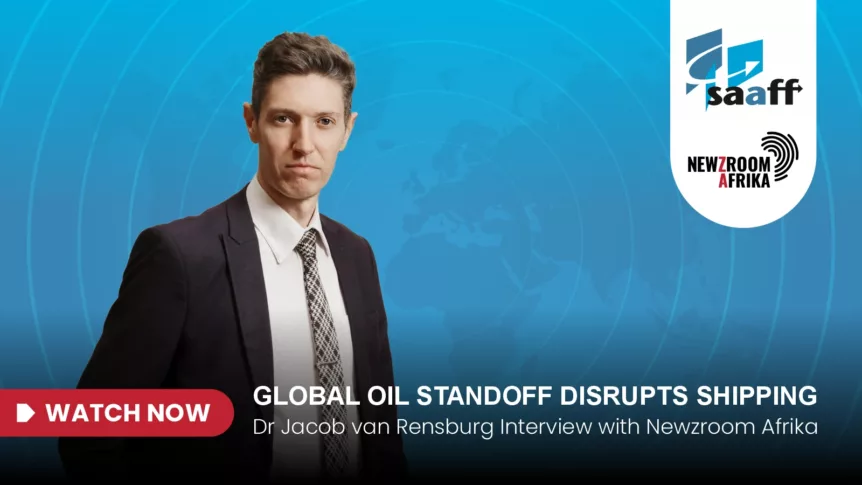
Dr Jacob van Rensburg from the Southern African Association of Freight Forwarders (SAAFF) joined Newzroom Afrika to unpack what this means for the economy, food prices and supply chains.
He explains that this is not just a shipping disruption, but an energy shock feeding into logistics, inflation and supply reliability. Over the past few years, global supply chains have already faced multiple crises, from COVID-19 to the Suez Canal blockage and the Red Sea disruptions. However, the current situation is different because it directly impacts energy supply.
Roughly one fifth of global oil and liquefied natural gas flows through the Strait of Hormuz. Current disruptions are estimated at around 12 million barrels per day. This makes the crisis not only a logistics issue, but also a fuel and inflation problem, with knock-on effects expected in the coming months.
Fuel is a major cost driver across all transport modes. It accounts for approximately 40–50% of road transport costs, 20–35% in global shipping, and is also significant in aviation. As a result, rising fuel prices impact the entire economy, from mining and agriculture to manufacturing and distribution.
Another major challenge is unpredictability. Logistics systems rely on reliability and planning, but current disruptions are adding delays and uncertainty across supply chains. This makes it difficult for businesses to plan production, deliveries and inventory.
While some shipping traffic has diverted around the Cape of Good Hope, South Africa has not seen a major increase in cargo volumes. Although 15–25% of global container capacity has shifted to this route, South Africa has only experienced modest growth in container volumes and vessel calls. Most ships are passing by rather than stopping.
The real opportunity for South Africa lies in services such as vessel refuelling, known as bunkering. However, to capitalise on this, the country needs improved port reliability and overall system performance.
Encouragingly, there have been improvements in port efficiency and collaboration across the logistics sector. While South Africa is not yet fully able to take advantage of global disruptions, progress is being made.
Fuel prices remain a key concern. In South Africa, fuel costs are passed through quickly into logistics and consumer prices. With road transport accounting for a large portion of freight movement, rising diesel prices place significant pressure on supply chains and ultimately on consumers.
Logistics costs currently account for about 10.5% of South Africa’s GDP. If the crisis continues, this could rise to between 12% and 14%, further increasing the cost of doing business.
Despite these challenges, the sector has shown resilience. However, ongoing disruptions are introducing additional inefficiencies, uncertainty and costs into the system.