+27 (0) 11 455 1726

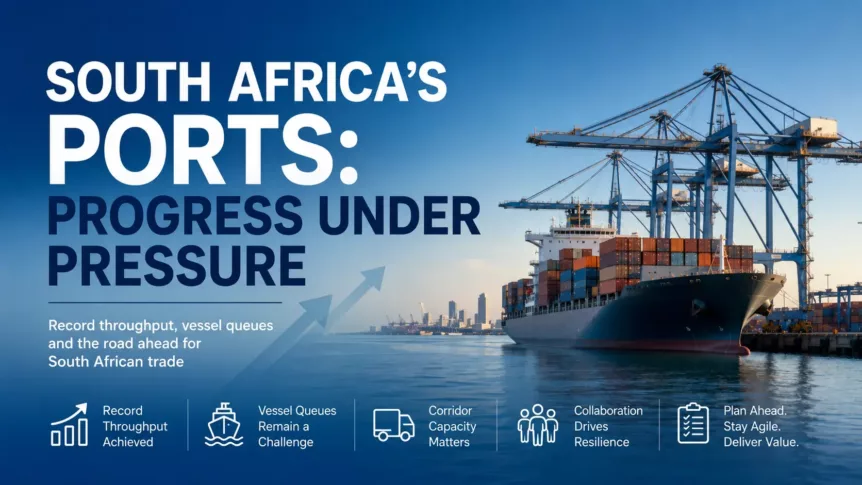
South Africa’s Ports Show Signs of Recovery, But Congestion Remains a Reality
South Africa’s port system is sending mixed, but ultimately encouraging, signals to the logistics industry. On the one hand, Transnet Port Terminals has achieved a record operational milestone, handling more than 100,000 twenty-foot equivalent units (TEUs) in a single week. On the other, vessel queues off Durban and Ngqura continue to highlight the pressure facing an increasingly busy freight network.
Far from being contradictory, these developments illustrate a port system operating at much higher capacity while simultaneously managing unprecedented demand.
A Positive Milestone for Port Operations
The record throughput represents one of the strongest indicators yet that South Africa’s ports are moving beyond years of operational disruption. Following prolonged periods of equipment failures, weather-related delays, infrastructure constraints and congestion, sustained improvements in terminal productivity are beginning to emerge.
Handling more than 100,000 TEUs in a week demonstrates that investments in operational efficiency and equipment reliability are starting to deliver measurable results. For importers, exporters, freight forwarders and shipping lines, this is a welcome development that reinforces growing confidence in South Africa’s gateway ports.
While a single record week does not define long-term performance, it provides encouraging evidence that the recovery trajectory is moving in the right direction.
Why Are Vessel Queues Still Growing?
Despite improved productivity, approximately 79 vessels have reportedly been waiting off the ports of Durban and Ngqura, with average waiting times remaining around two days at both Durban and Cape Town during the reporting period.
The explanation lies not in declining performance, but in rising demand.
Global shipping patterns continue to be influenced by vessel diversions around the Cape of Good Hope, while seasonal export volumes place additional pressure on South African infrastructure. As more cargo arrives, terminals may process record volumes yet still struggle to eliminate vessel queues entirely.
In simple terms, the ports are moving more freight than ever before, but they are also receiving more freight than ever before.
The Challenge Extends Beyond the Port Gates
Port performance is only one part of the logistics equation.
For containerised cargo, improvements at the quayside must be matched by efficient truck movements, terminal gate operations and warehouse capacity. Delays in any part of the landside logistics chain can quickly reduce the benefits achieved within the terminal itself.
Bulk commodity exporters face an additional challenge. For sectors such as chrome, manganese and other mineral exports, rail and road corridor constraints often become the limiting factor rather than the port infrastructure itself. Even where vessels are loaded efficiently, inland transport bottlenecks can delay cargo reaching the port on schedule.
This highlights the importance of viewing the supply chain as an integrated network rather than focusing solely on terminal performance.
Building Resilience Across the Supply Chain
South Africa’s strategic location continues to place its ports at the centre of regional and international trade. With global shipping patterns evolving and additional cargo moving around the southern tip of Africa, demand on local infrastructure is unlikely to ease in the near future.
The recent throughput record demonstrates that operational improvements are achievable. However, maintaining this momentum will require continued investment in port equipment, maintenance, digital systems, rail infrastructure and road freight corridors.
The logistics industry has consistently demonstrated its ability to adapt to changing conditions, but resilience depends on collaboration across the entire supply chain, from ports and terminals to transport operators, freight forwarders, customs professionals and cargo owners.
Looking Ahead
The latest performance figures should be viewed as a positive milestone rather than a declaration of victory. South Africa’s ports appear to be on a path of gradual recovery, but the system continues to operate under significant pressure from increasing cargo volumes and evolving global trade routes.
For logistics professionals, the message is clear: acknowledge the progress, continue planning with realistic lead times, and remain agile as operating conditions evolve.
The recovery is real, but so too are the challenges. Sustaining this positive trajectory will require continued cooperation, investment and careful planning across the entire logistics ecosystem.